
Global System Collapse
A Systems Theory Perspective

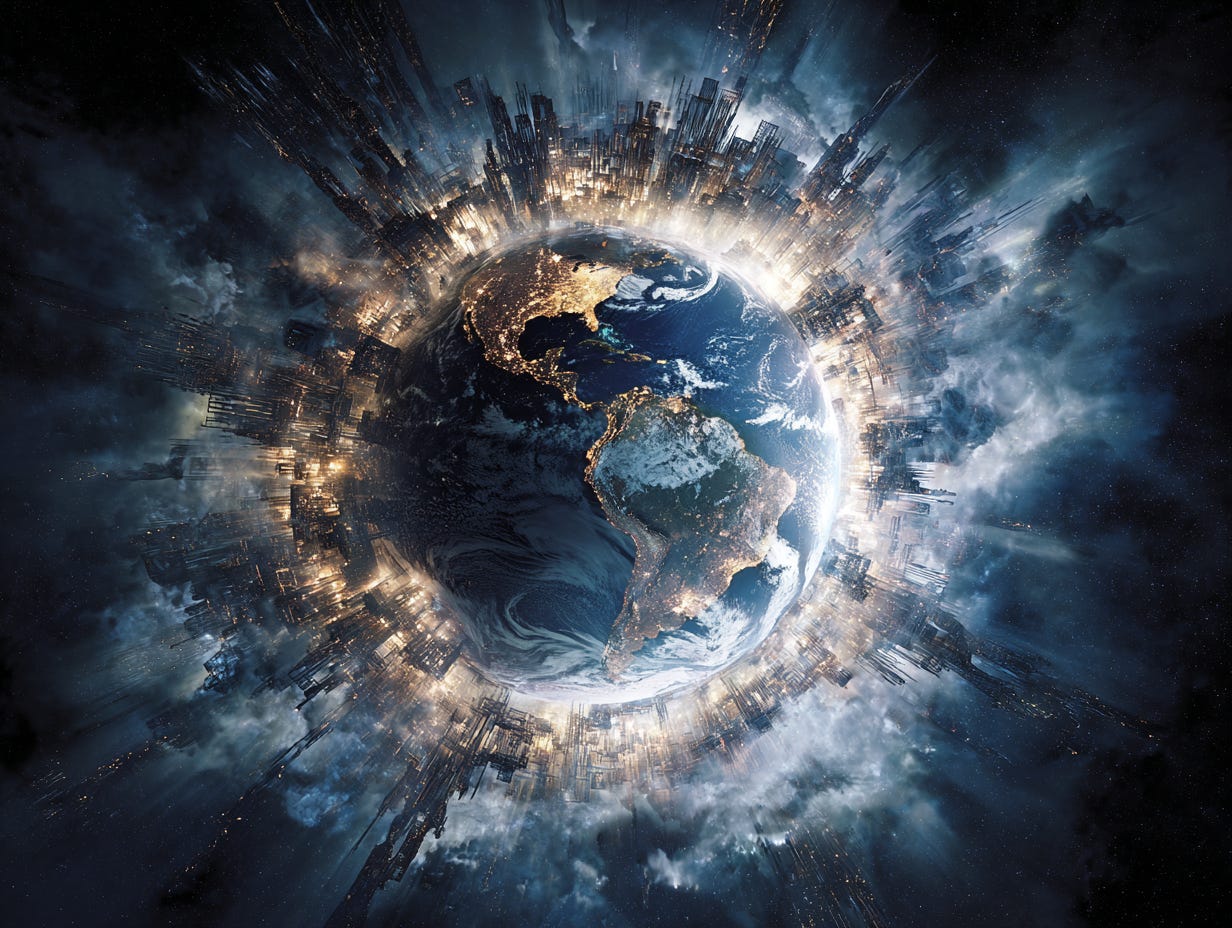
For decades analysts have warned that the modern global system is fragile. Built on complex networks of finance, energy, politics, supply chains, and information infrastructure, it works extraordinarily well—until it doesn’t.
In my view, based on a number of indicators across geopolitics, economics, and social stability, we may now be entering the early stages of a systemic shift.
What we are witnessing may not be a single crisis but a cascade of failures across interconnected systems: political institutions, financial markets, food distribution networks, supply chains, and potentially even information infrastructure such as the internet.
Modern civilization is deeply networked. The same interconnection that makes globalisation efficient also means stress in one domain can rapidly propagate through others.
From a “witness perspective”—stepping back to look at the big picture—these dynamics can be understood through the lens of systems theory.
Interestingly, this brings me back to my time at university studying pure mathematics. One of the modules we covered was catastrophe theory, developed by the French mathematician René Thom.
Thom received the Fields Medal in 1958, often considered the mathematical equivalent of a Nobel Prize, for his work in topology and related fields.
His work explained something very striking about complex systems: continuous changes in conditions can suddenly produce abrupt and dramatic changes in outcomes.
In other words, systems can appear stable for a long time and then suddenly “snap” into a completely different state.
Thom showed that these kinds of transformations can be described mathematically and geometrically using surfaces with folds, cusps, and other singularities. In modern language we might simply call these tipping points.
You can watch an accessible introduction here:
Bifurcations and the Butterfly Effect
Closely related ideas appear in the work of the Nobel Prize–winning chemist and physicist Ilya Prigogine.
Prigogine studied far-from-equilibrium systems, showing that when complex systems reach certain thresholds they enter bifurcation points—moments where the system can suddenly reorganize into a new structure.
Near these bifurcations, small fluctuations can determine the entire future path of the system. This idea is closely related to what is popularly known as the butterfly effect.
Five Principles of Systems Transformation
My friend Christof Melchizedek recently summarized these dynamics very clearly in an email outlining five core principles from systems theory.
These are particularly relevant to the current moment.
1. Emergence
The whole is greater than the sum of its parts. Complex systems generate behaviours that cannot be understood simply by analysing individual components.
2. Feedback Loops
Systems maintain stability through feedback mechanisms. When those feedback loops break down, rapid destabilisation can occur.
3. Attractors
Systems tend to settle into patterns of behaviour known as attractors. At critical moments, new attractors can appear and pull the system into an entirely different configuration.
4. Tensegrity
A concept popularised by Buckminster Fuller.
In a tensegrity structure, many nodes are held together under tension. Stress applied in one location propagates through the entire structure. This is an excellent metaphor for modern global civilisation.
Everything is connected.
5. Phase Transitions
When systems cross certain thresholds, change happens extremely quickly.
Water turning to ice.
Water turning to steam.
In complex systems the same thing happens: long periods of apparent stability followed by sudden transformation.
Are We Approaching a Global Phase Transition?
If we apply this framework to the current global situation, several patterns stand out. Multiple systems are simultaneously under stress:
global debt levels
geopolitical fragmentation
energy transitions
supply chain fragility
ecological limits
information warfare and narrative breakdown
artifical intelligence ramifications
These pressures interact with one another. Systems theory suggests that when multiple feedback loops fail simultaneously, the probability of a large-scale phase transition increases dramatically. This does not necessarily mean “the end of the world”. In an earlier post I likened the transition to Frashokereti - making the World anew.
History shows that large civilizational shifts often occur in exactly this way: not gradually, but through punctuated bursts of transformation, sometimes accompanied by wars or periods of social unrest.
Observers, Not Just Participants
If such a transformation is unfolding, the most useful stance to adopt is that of the observer rather than the reactor.
Complex systems behave in ways that are largely beyond the control of any single actor. However, we are all nodes in the matrix. If we hold a higehr level perspective then the transition period (that we are currently experiencing) can be undergone with out much turbulence. Some thinkers frame this as the emergence of new ethical and technological paradigms, such as those discussed in Christof Melchizedek’s paper Toward a Krystic Technology Ethic.
Remote viewers
I have also followed the work of Courtney Brown and his team of remote viewers at the Farsight Institute. Brown has also suggested that we may be entering the early stages of systemic collapse. I recently subscribed to their FarsightPrime service to follow their latest work, as access to reliable information may become increasingly important during periods of systemic change.
Jason Jorjani
I have also been listening to Jason Jorjani, who has predicted a series of potential “convergent catastrophes” between roughly 2027 and 2045.
These could include:
global pandemics caused by antibiotic-resistant pathogens
major solar storms causing widespread power outages
geophysical crustal shifts and tsunamis
sea-level rise from melting Antarctic and Greenland ice
civil conflicts and resource wars as societies struggle to adapt
While humanity may not experience all of these scenarios, they illustrate the scale of challenges that complex systems can generate when multiple stress factors converge.
A Moment of Transformation
Putting all this togther, the global system colapse will lead to a bifurcation event - like the one preducted by Dolores Canon - where this reality spits into Two Earths - The New Earth for people choosing to live in 5th density (5D) consciousness and the old earth which will descend into a nightmare dystoopian future which may include all the convergent catastrophes highlighted by Jason Jorjani.
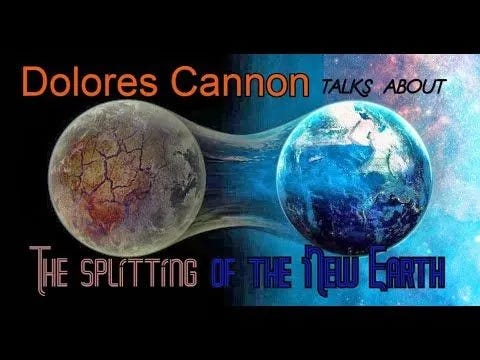
This bifurcation event is rapidly approaching - it leads to collapse of the old systems and the arising of a new system - based on the Krystic Operating System (as explained by Christof).
The challenge will not simply be surviving the transition, but navigating it consciously — learning, adapting, and perhaps even transforming the structures of civilization itself. Periods of turbulence in complex systems often precede the emergence of entirely new orders. The question is not simply whether the current system is changing.
The deeper question may be:
What kind of system will emerge on the other side?